Review required
Calculations, formulas, data, and deliverables must be checked before approval.
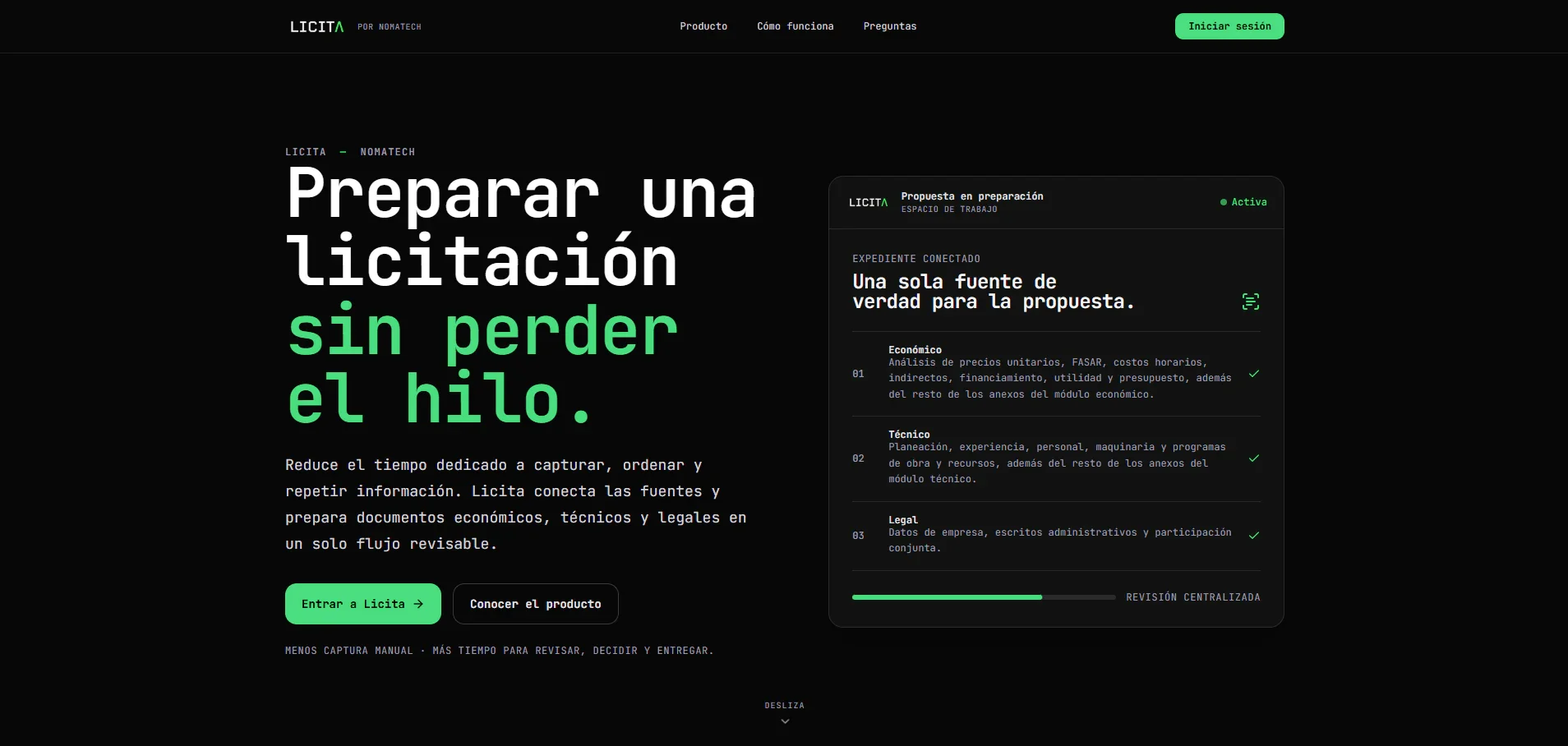
Licita · A Nomatech product
Licita connects every source in a proposal and brings economic, technical, and legal document preparation into one reviewable workflow.
In development · 2025–2026
Licita captures and structures information inside each bid so it can be reused across economic, technical, and legal documents.
The team spends less time rebuilding forms and more time checking requirements, calculations, and deliverables before submission.
Unit price analysis, FASAR, hourly costs, overhead, financing, profit, budget, and related appendices.
Planning, experience, personnel, machinery, work schedule, and resource programs.
Company data, administrative statements, joint participation, and corporate documentation.
Each stage keeps the bid context intact and makes the remaining review work visible.
Collect the notice, bid documents, catalogues, and specifications.
Turn long files into information the team can verify.
Generate economic, technical, and legal documents for the project.
Review status and deliverables before downloading them.
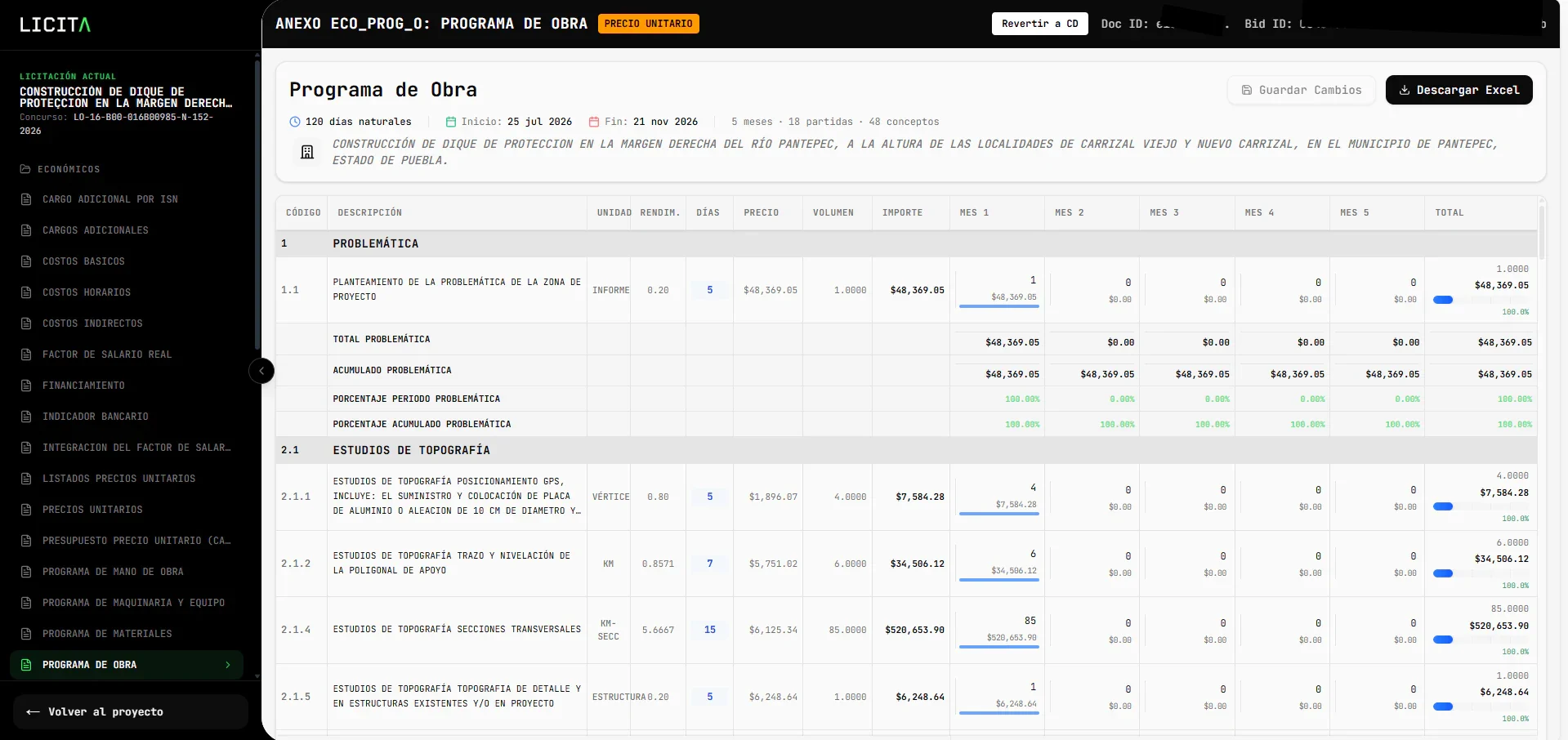
The dashboard brings active projects, progress, and deadlines together. Inside each record, modules share context and keep proposal status visible.
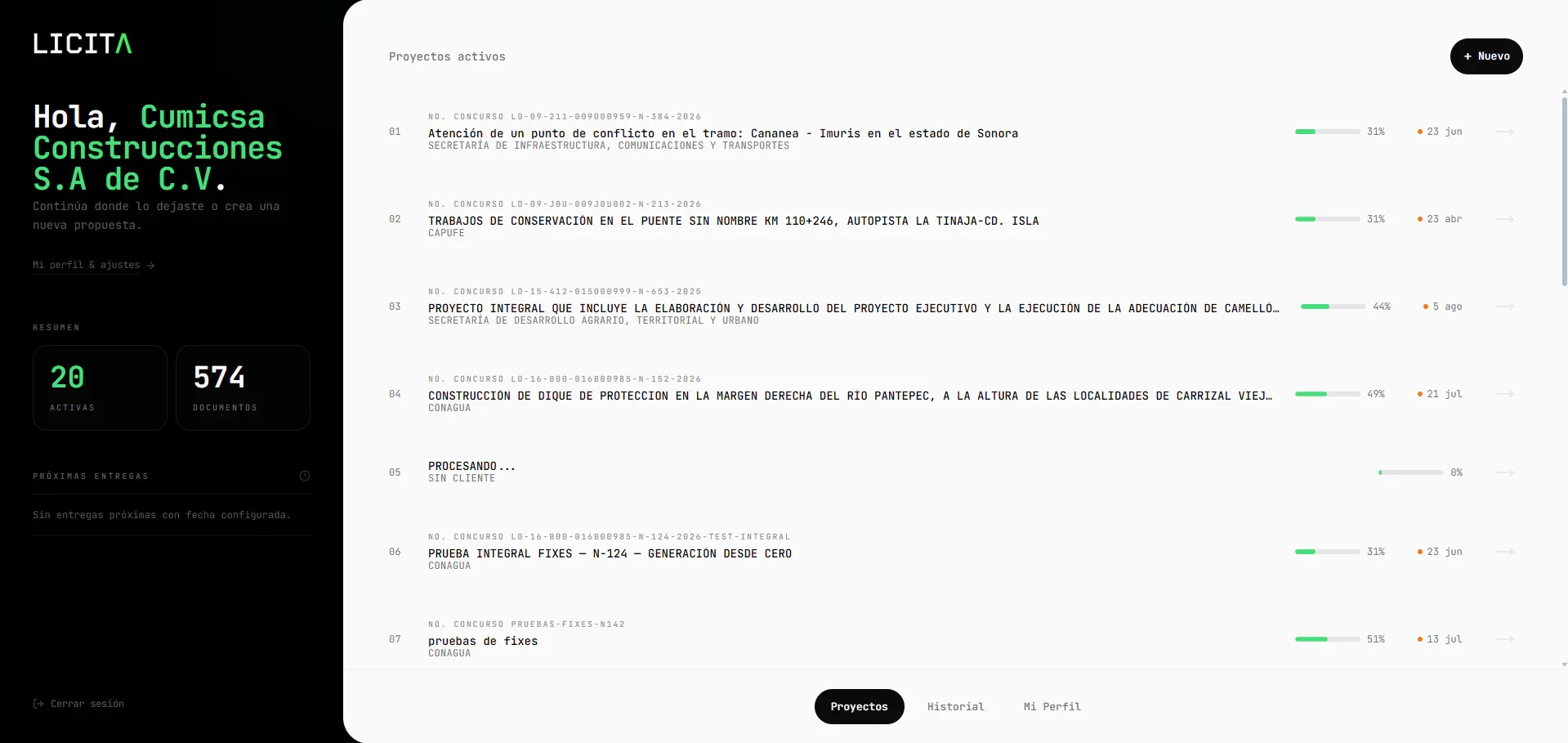
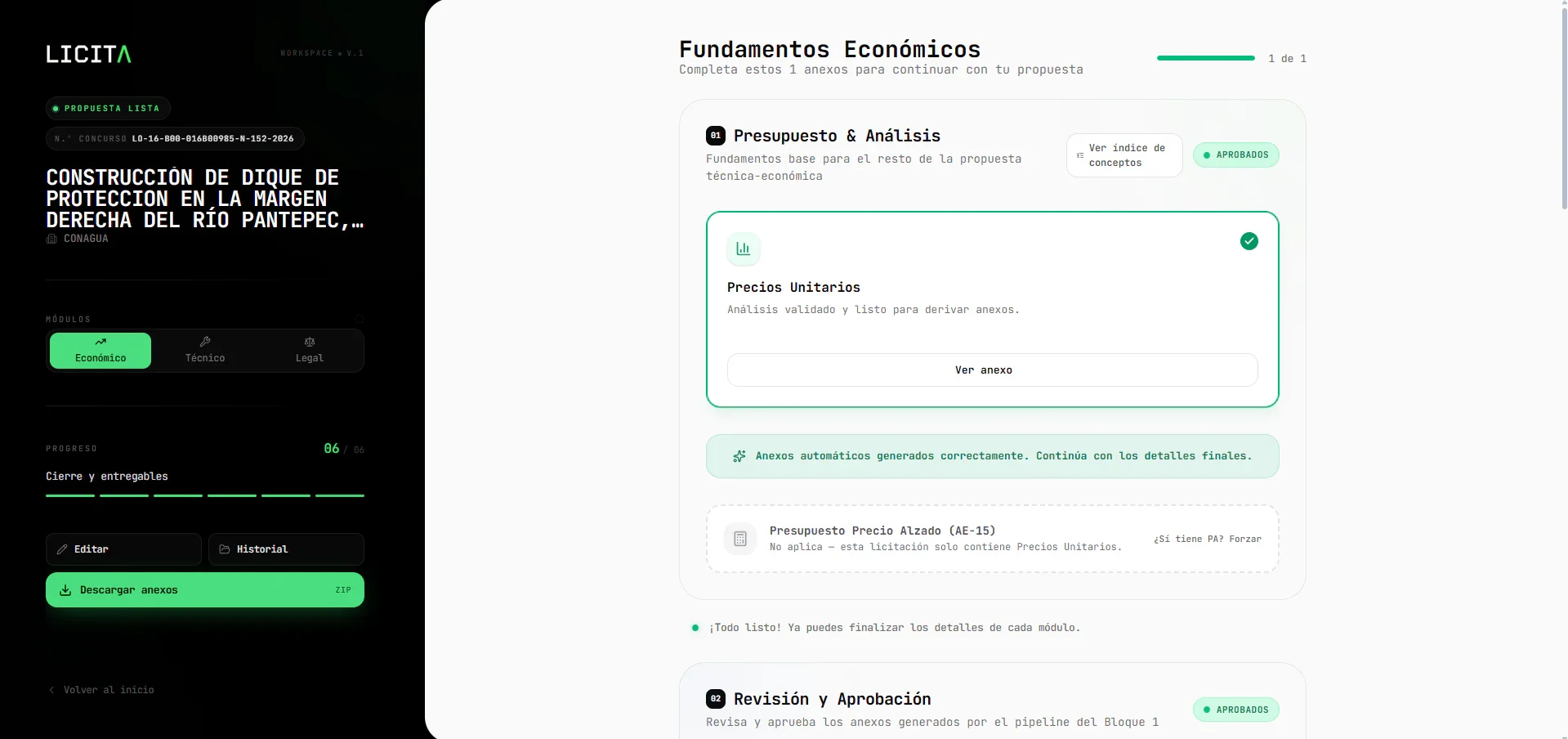
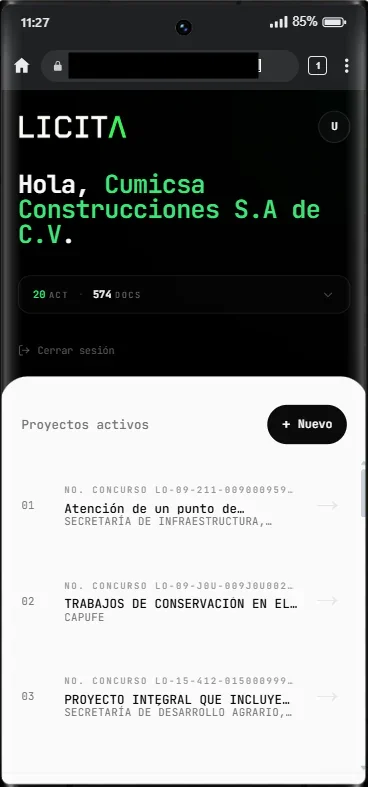
The dashboard, bid record, and unit prices reflow for vertical reading. Primary actions remain visible instead of shrinking the desktop product into a thumbnail.
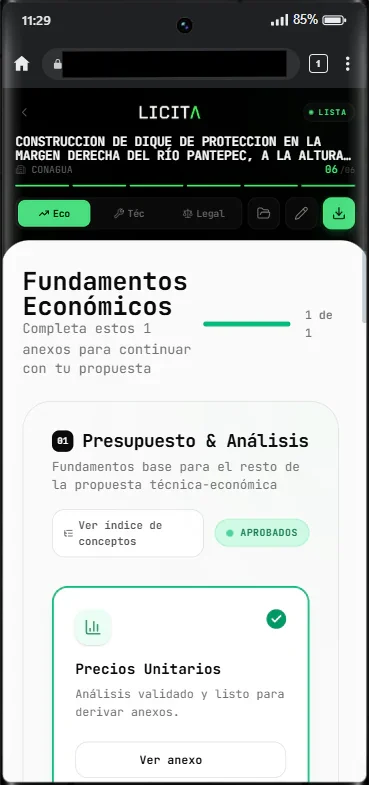
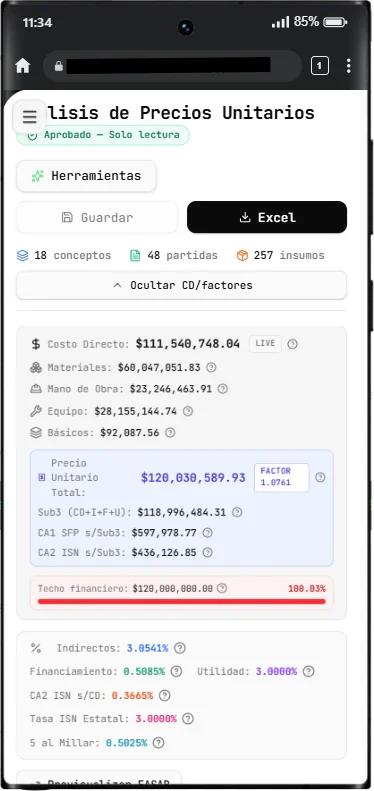
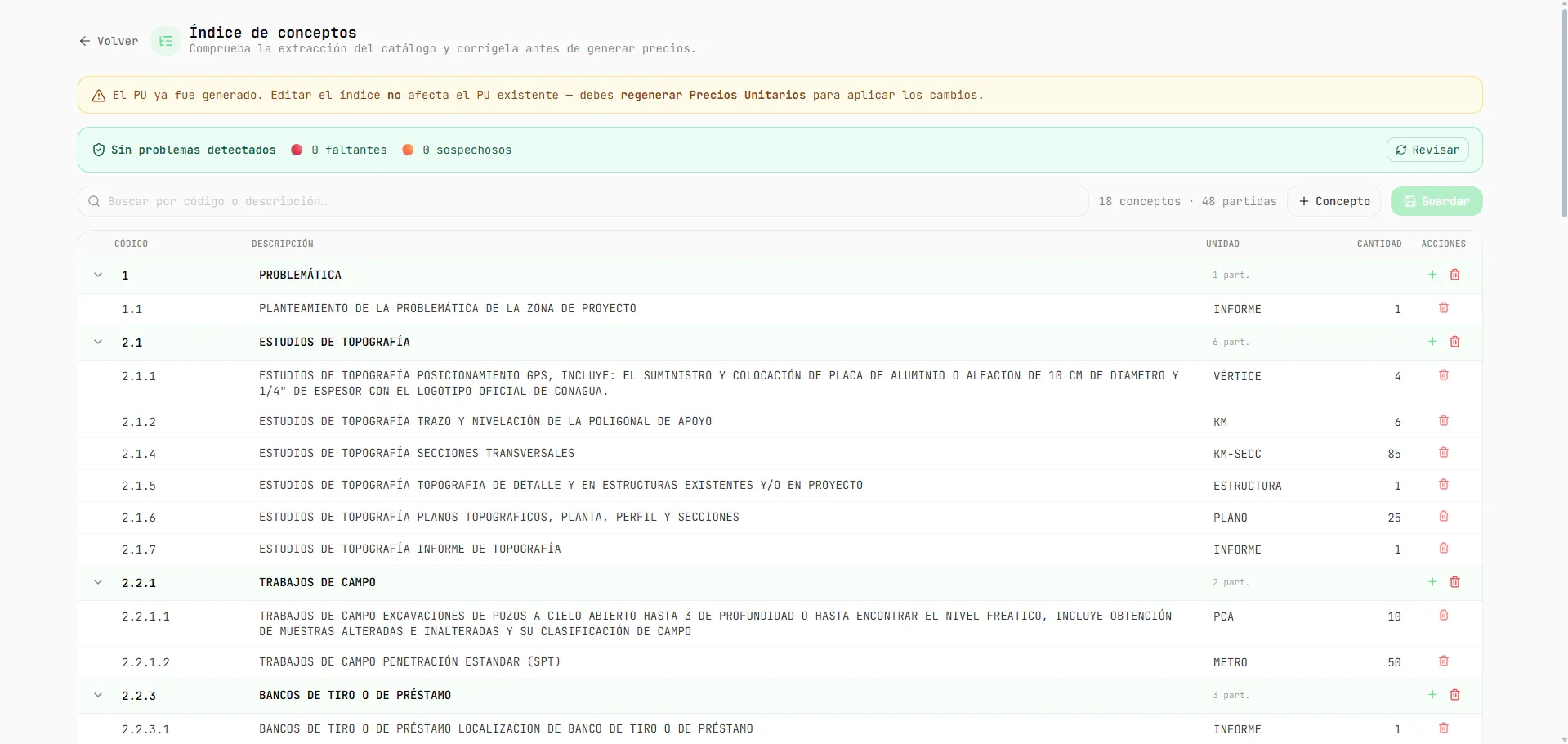
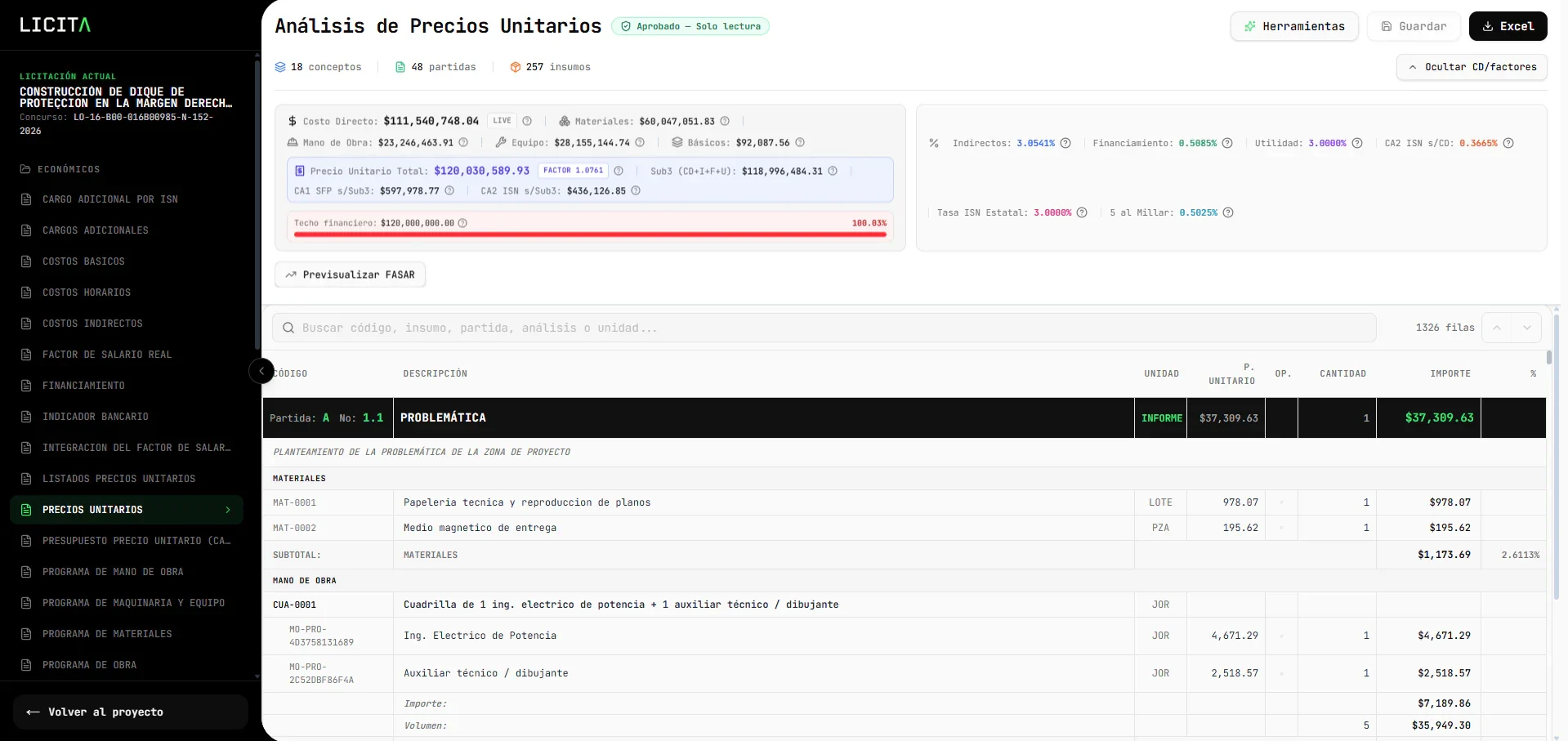
The concept index is reviewed before prices are generated. Costs, factors, items, and schedules then share one base instead of becoming disconnected captures.
Next.js and TypeScript power the product experience; FastAPI and Python process documents and coordinate tasks. WebSockets report progress so the team never has to guess what is happening.
Azure Document Intelligence extracts structure from notices, requirements, catalogues, and appendices.
FastAPI, Python, and SQLAlchemy coordinate files, data, and modules for each bid.
WebSocket channels stream status during longer-running operations.
The workflow prepares reviewable documents and reports, including PDF and Excel output.
My role in Licita
Licita expanded my work far beyond full-stack development. I took on product architecture, technical leadership, and project management responsibilities in a domain that was entirely new to me: public works procurement.
To program the process, I first had to understand how it was completed by hand. I prepared bids, followed the production of each appendix, and stayed in constant communication with domain specialists and the development team.
An architecture decision
I used Excalidraw to map dependencies between appendices and discuss them with the team. That made it possible to decide what needed recalculation, what could be reused, and where human validation belonged.
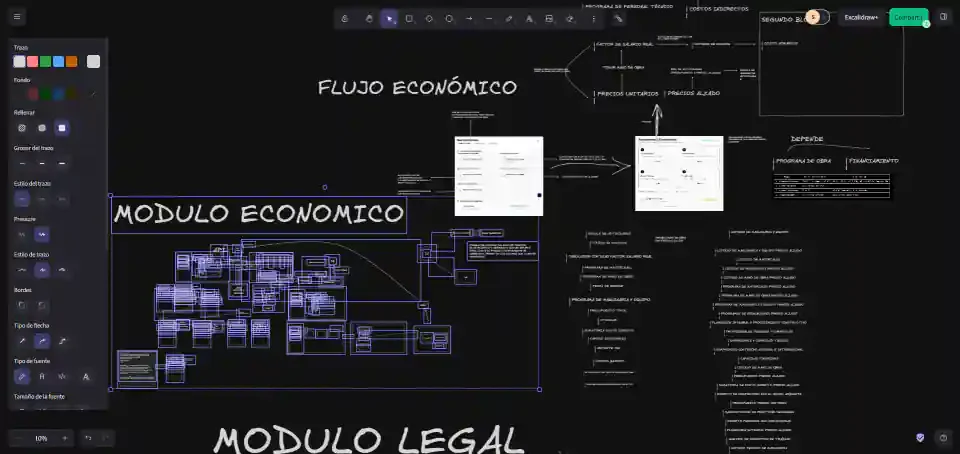
I listened to the people who knew the process, participated in manual bid preparation, and documented the problems found during capture, review, and correction. That work showed that appendices are not isolated files: they form a network where one price change can affect budgets, schedules, overhead, and related deliverables.
I organized the work with Kanban and used Excalidraw to model how each appendix was generated. With no sufficiently complete reference product, every workflow had to be discovered, validated with specialists, and translated into rules the team could implement.
We handled scanned records of up to 1,000 pages through OCR, normalization, LLM extraction of key data, batching to respect API limits, and parallel processing. On 1,500-item projects, a sequential flow could approach three hours of processing before Excel generation even began.
Every agency publishes its own official formats. We first used master appendix templates stored in Supabase, then moved to generating Excel files entirely in code. The shift was more complex, but improved version control, reproducibility, and the ability to adapt formats.
I participated in preparing more than 15 bids submitted through Compras MX. Early evaluations exposed mistakes and opportunities; every observation returned to the backlog and became a product decision. Our latest technical evaluation reached 43.5 out of 50 points, and the economic evaluation also produced a strong result.
Scoring also covers staff experience, previous construction work, and other contractor-specific attributes. Not every point depends on Licita, so the result is presented with that context.
It was demanding and deeply formative work: I learned to connect domain knowledge, product decisions, software architecture, and team execution under real constraints in time, budget, and compute.
Automation reduces repetitive work, but it does not replace professional validation or guarantee an award.
Marked unit-price, overhead, hourly-cost, and other processes may use AI and require review. Corporate profile data follows rules and templates so it can be inserted without being sent to AI for legal or technical autocomplete.
Calculations, formulas, data, and deliverables must be checked before approval.
Assistance is limited to the processes identified inside the product.
Company profile data is reused through rules and templates in technical and legal appendices.
Direct answers about what Licita prepares, its supported bid modes, agency templates, and bounded use of artificial intelligence.
Licita is a workspace for collecting source files, structuring requirements, and preparing economic, technical, and legal documents for public works bids in one reviewable flow.
It helps generate documents and appendices from structured, reusable information. It does not submit the proposal for the team or replace professional review.
The product supports unit-price, lump-sum, and mixed bids, plus a generic template for agencies without a specific adaptation.
Current adaptations cover CONAGUA, CAPUFE, SICT, SEDATU, CFE, and IMSS. Compatibility does not imply affiliation, certification, or endorsement.
Marked processes such as unit prices, overhead, and hourly costs may use AI. Results can contain errors and always require human validation.
Licita keeps expanding with new templates and modules while preserving one rule: automation prepares; the team validates.